I Spy “Flip” Board Game: Real Life Apples
Recommended Grade Level:
Type of Resource: PDF
Number of Pages: 21

You must be a Monthly, Annual or Forever Member to Access this Resource.
Join the Life Over C’s Club to Access

Already a member? Login below:
Coordinating Activities




Real Life Apples I Spy “Flip” Board Game
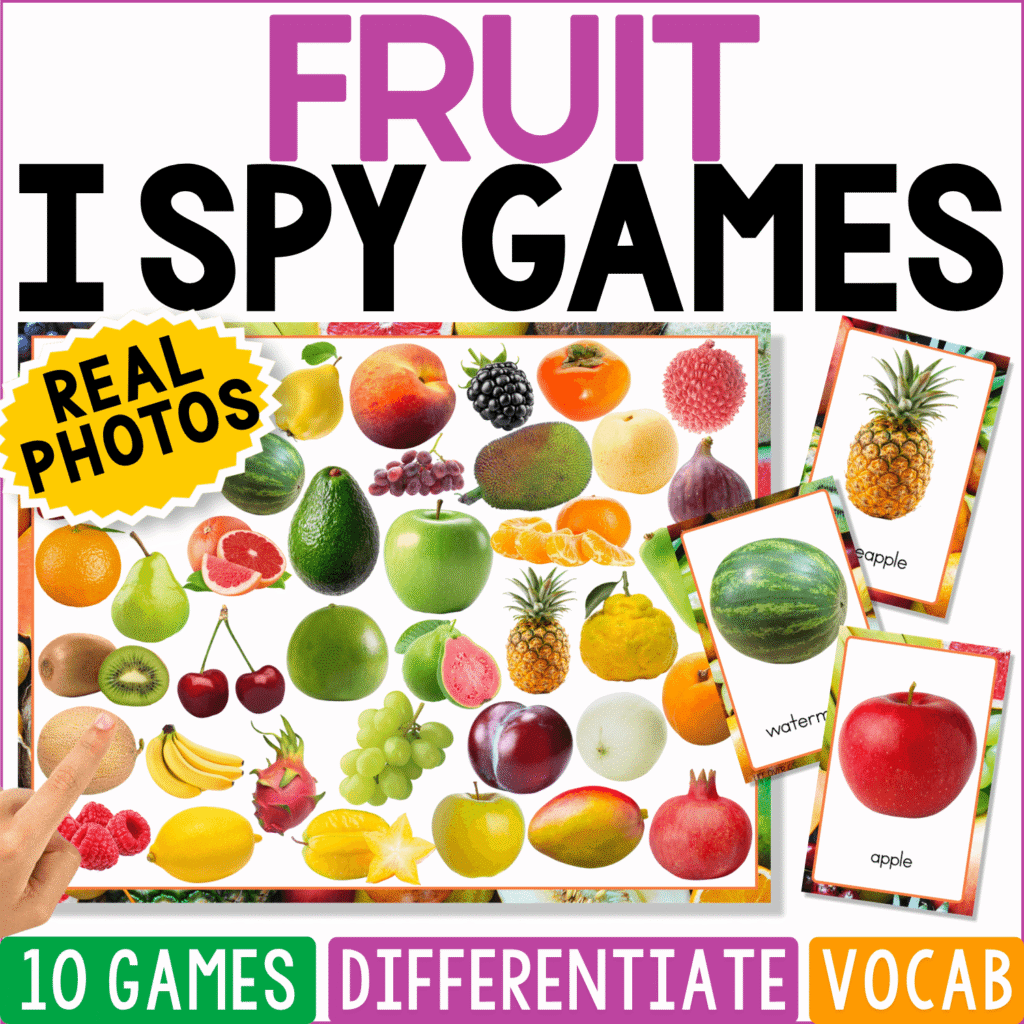
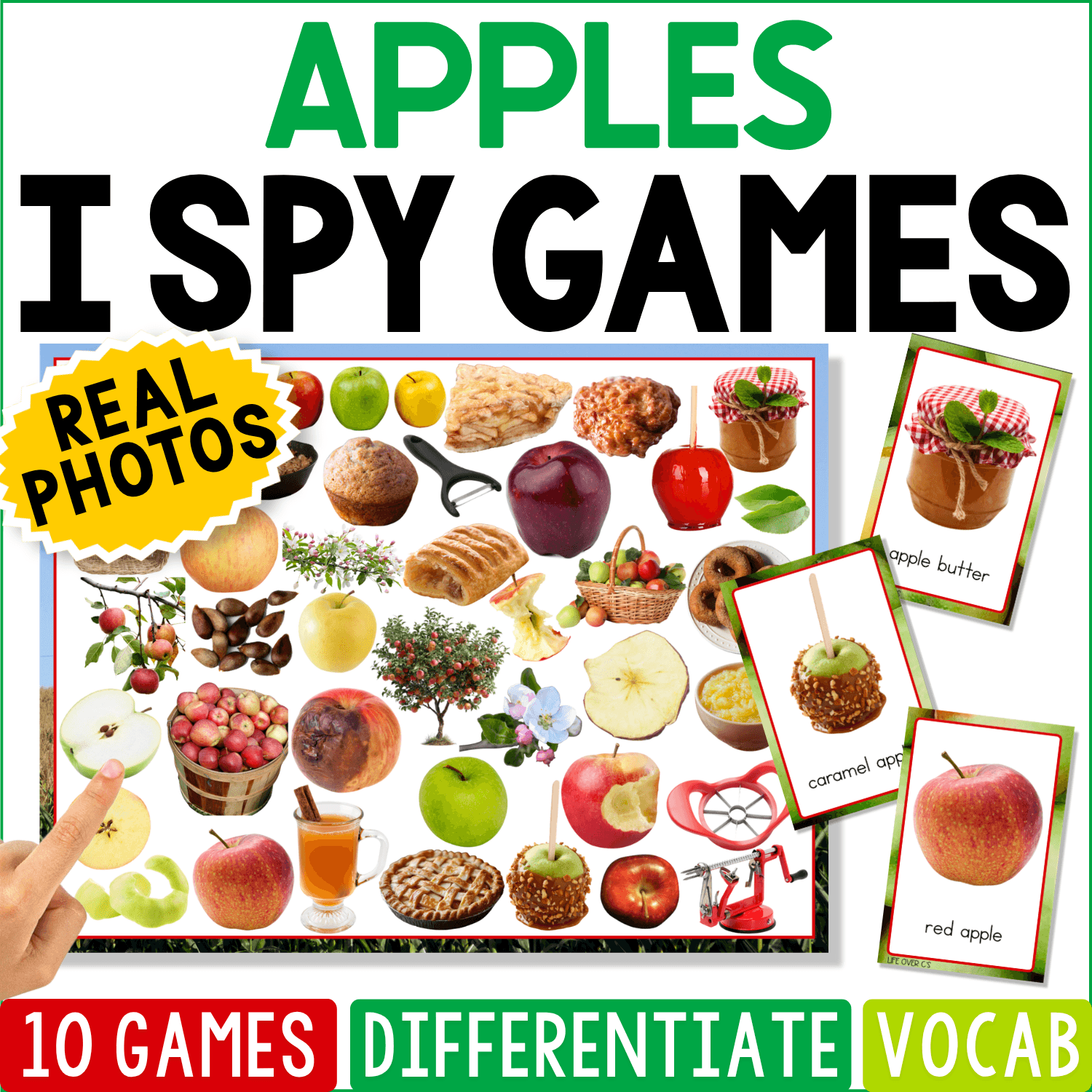
- 40 real photo I Spy picture cards, 8 to a page (apples, apple trees, apple blossoms, apple pie, apple cider donuts and more)
- 10 full-color real photo I Spy game boards
- 1 page of 20 apple tokens
- Table of contents and preparation directions
- I Spy “Flip” game instructions
The real photos match what kids see in everyday life, which makes it easy to connect new words to real things. Some photos look a lot alike, like the different red, green and yellow apples, so kids have to check the details to find the exact match.
Required Materials:
- White cardstock, printer and ink
- Laminator
- Paper cutter or scissors
- Optional: mini erasers or counters to use as tokens
Standards for Vocabulary and Speaking and Listening
This real photo apples I Spy game supports early learning standards connected to apple vocabulary, visual discrimination and taking turns in conversation.
Common Core State Standards: English Language Arts
- CCSS.ELA-LITERACY.L.K.5.A: Sort common objects into categories to gain a sense of the concepts the categories represent. Kids sort the photos into apples, apple treats and apple tools.
- CCSS.ELA-LITERACY.L.K.5.C: Identify real-life connections between words and their use. Kids talk about apple words they know from real life.
- CCSS.ELA-LITERACY.SL.K.1: Participate in collaborative conversations with peers and adults in small and larger groups. Players take turns, name the pictures and talk about each match.
Texas Prekindergarten Guidelines and TEKS for English Language Arts and Reading
- PK4.II.D.1: Child understands and uses a wide variety of words to label and describe people, places, things and actions. Kids name and describe each apple picture they find.
- PK4.II.D.3: Child consistently understands and uses new vocabulary learned through books, conversations and play. Every round brings more chances to hear and use the theme words.
- TEKS K.1(D): Work collaboratively with others by following agreed-upon rules for discussion, including taking turns. Players take turns flipping cards and searching the board.
Virginia English Standards of Learning
- K.RV.1.C: Use vocabulary from across content areas. Kids build apple vocabulary as they play.
- K.RV.1.F: Use newly learned words and phrases in discussions and speaking activities. Kids name each picture when they find it.
- K.C.1.A.i: Listen actively and follow agreed-upon rules for participating in discussions. Kids take turns and wait for each player to flip.
The Real Life Apples I Spy “Flip” Board Game gives preschool and kindergarten kids hands-on practice with visual discrimination and apple vocabulary using 40 real photo cards and 10 colorful game boards.
Flip a card and find the caramel apple! Kids race to spot real photos of apples, apple treats and orchard tools on a busy I Spy board.
The real photo cards show apples, apple trees, apple blossoms, apple pie, apple cider donuts, caramel apples, baskets of apples and apple slicers. Some photos look a lot alike, like the different red, green and yellow apples, so kids have to check the details to find the exact match.
Kids who aren’t reading yet can play right along, since every match is made by looking at the photos. Name each picture as you go to build vocabulary while kids search.
With 10 different game boards, the same photos land in new spots each round. That keeps the search fresh while kids build visual scanning, focus and attention to detail.
How to Play the Apples I Spy Game
- Choose one I Spy game board and place it where every player can see it. Deal the picture cards face down so each player has a small stack.
- All players flip their top card at the same time and race to find the matching picture on the board.
- The first player to point to the right picture names it, then wins an apple token or keeps the card as a point. Play until every card is flipped. The player with the most points wins!
Cooperative Play: Put the picture cards in one shared pile. Kids take turns flipping a card and work together to find it on the board. Cover each match with a token to see how many pictures the group can find.
Independent Play: Set one board and a stack of cards in a learning center. Kids flip one card at a time, find the picture and name it. Covering each picture with a token or mini eraser adds a little fine motor practice.
Easy Ways to Differentiate This Apples I Spy Game
Apple season is perfect for this game. Some kids think every apple is red, some can name a caramel apple and an apple pie and some are ready to talk about how apples grow from a blossom to fruit. The real photos give every child something to notice and talk about.
For Children Who Need More Support:
- Start with the whole apples and the apple tree. Simple, familiar photos help kids learn the game first.
- Bring in a red, a green and a yellow apple to hold while you play. Real apples teach the color words on the cards.
- Name each card with a color word, like “green apple” or “red apple.” Kids search by color, which narrows the board.
- Play cooperatively so kids have time to look for small differences between apples.
For On-Level Practice:
- Sort the cards into apples, apple foods and apple tools like the slicer and basket. Grouping by kind builds category language.
- Compare the red, green and yellow apples and talk about what is the same and different. Comparing color and shape is the close looking this game practices.
- After each match, ask “Is this crunchy or soft?” Texture words build describing language.
- Put the blossom, tree and apple cards in order to show how an apple grows.
For an Extra Challenge:
- Explain how apples become cider donuts or pie, step by step. Telling a process builds sequencing language.
- Graph the apple colors on the cards and talk about which color has the most. Reading a simple graph adds math to the game.
- Write a short recipe using three card words, like apple, pie and slicer. Writing with card words gives kids a real reason to spell.
- Give clues about where each apple item is found, like an orchard or a kitchen, for a partner to find. Clue-giving makes kids think about where things come from.
For Speech, OT, ELL or Special Education Support:
- Speech: practice /p/ in apple and pie, /k/ in caramel and /s/ in slicer and cider. Choose the cards that match the child’s goal sound.
- Fine motor: use a real apple slicer with an adult after the game. Pressing down builds hand strength.
- ELL: taste three apple colors and teach sweet, sour and crunchy. Taste words become real when kids try them.
- Sensory: let kids smell a real apple or cinnamon during play if they need a calming break.
Apples I Spy Game Is Perfect For:
- Preschool and pre-K
- Kindergarten
- Apple and fall themes
- Johnny Appleseed Day
- Small-group instruction
- Speech and language therapy
- Occupational therapy
- Special education
- ELL and multilingual learners
- Homeschool
- Early finishers