
Life Cycle Board Game: Butterflies
Recommended Grade Level:
Type of Resource: PDF
Number of Pages: 41


Coordinating Activities


What’s Included in the Butterfly Life Cycle Board Game
- Single page game board and cards
- File folder game board, cards, color-in game pieces and folder label
- Extra large floor game pictures and cards
- Instructions for each version
- Color and black and white versions
The cards and spaces show eggs, a caterpillar, a chrysalis, a butterfly coming out of its chrysalis, an adult butterfly and flowers.
Required Materials:
- Printer, paper and ink
- Scissors
- File folder and glue or tape for the file folder version
- Painter’s tape for the floor version
- Game pieces
Standards Connections
Moving through the stages and talking about how a butterfly grows connects the butterfly life cycle board game with these early science and language standards.
Next Generation Science Standards
- K-LS1-1: Use observations to describe patterns of what plants and animals need to survive.
- 1-LS3-1: Make observations to construct an evidence-based account that young plants and animals are like, but not exactly like, their parents.
Common Core State Standards
- CCSS.ELA-LITERACY.SL.K.1: Participate in collaborative conversations with diverse partners about kindergarten topics and texts.
- CCSS.ELA-LITERACY.L.K.6: Use words and phrases acquired through conversations, reading and being read to and responding to texts.
Texas Prekindergarten Guidelines
- PK4.VI.B.4: Child observes, investigates, describes and discusses the characteristics of organisms.
Virginia Standards of Learning
- Science K.7: Investigate and understand that plants and animals have basic needs and life processes.
Skills Students Practice
- Life cycle sequencing: putting the stages of a butterfly’s life in order.
- Science vocabulary: egg, caterpillar, chrysalis and butterfly.
- Visual matching: finding the next space that matches the card.
- Turn-taking: waiting, drawing and moving in a group game.
- Gross motor skills: moving along the floor path.
- Good sportsmanship: handling setbacks like flower cards.
Life Cycle Board Game: Butterflies
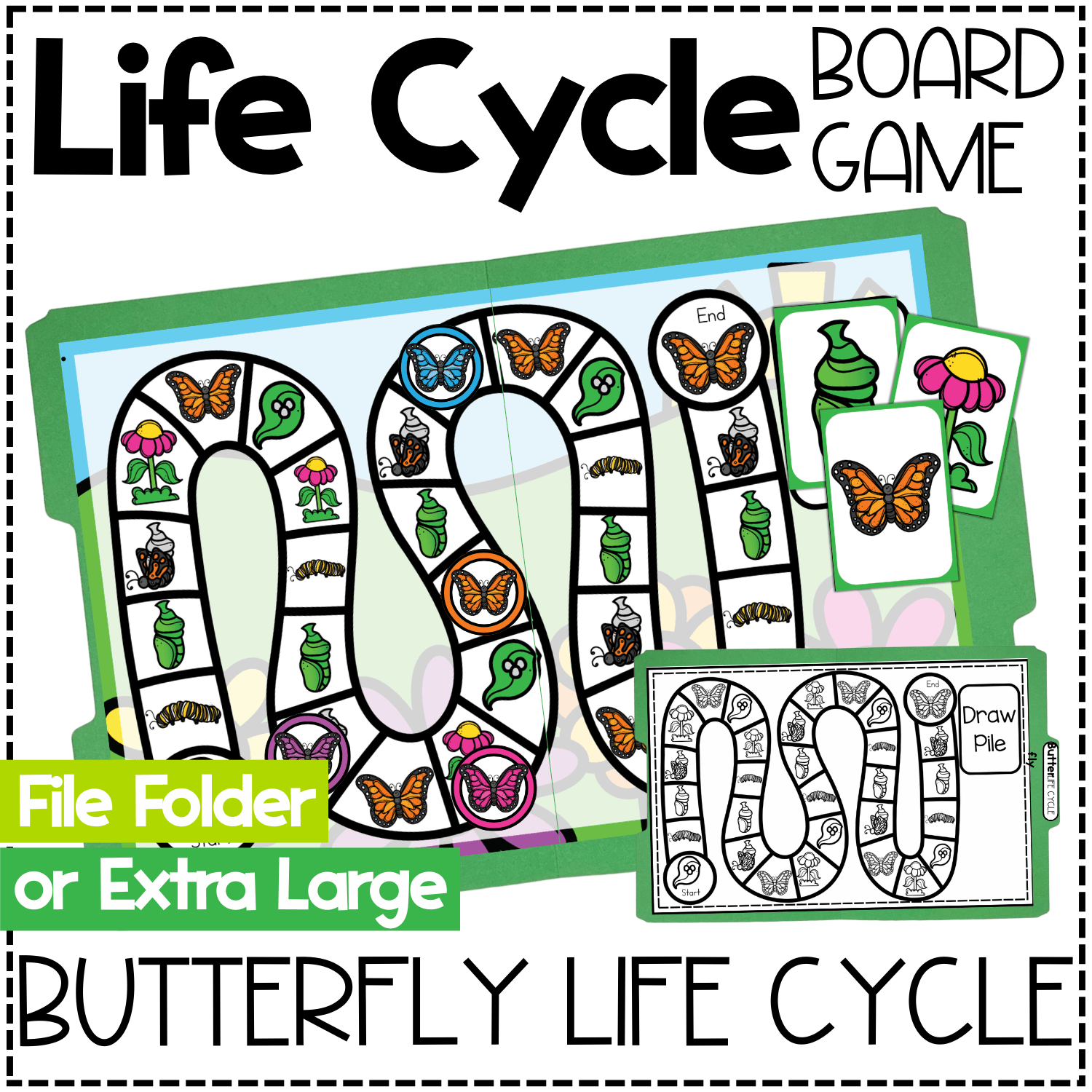
The Butterfly Life Cycle Board Game is a draw-and-move science game where preschool and kindergarten students follow a path of eggs, caterpillars, chrysalises and butterflies, with a single page board, a file folder board and an extra large floor version.
Kids remember what they move through. In this game, players draw a card, move to the next matching life cycle picture and talk about each stage as they go, from a tiny egg on a leaf to a butterfly climbing out of its chrysalis.
The path uses five stages: eggs, caterpillar, chrysalis, a butterfly coming out of its chrysalis and an adult butterfly. Flower cards add a twist, because they can send you back to the nearest flower.
Play it as a single page board at a table, a file folder game for centers or an extra large floor path where kids become the game pieces.
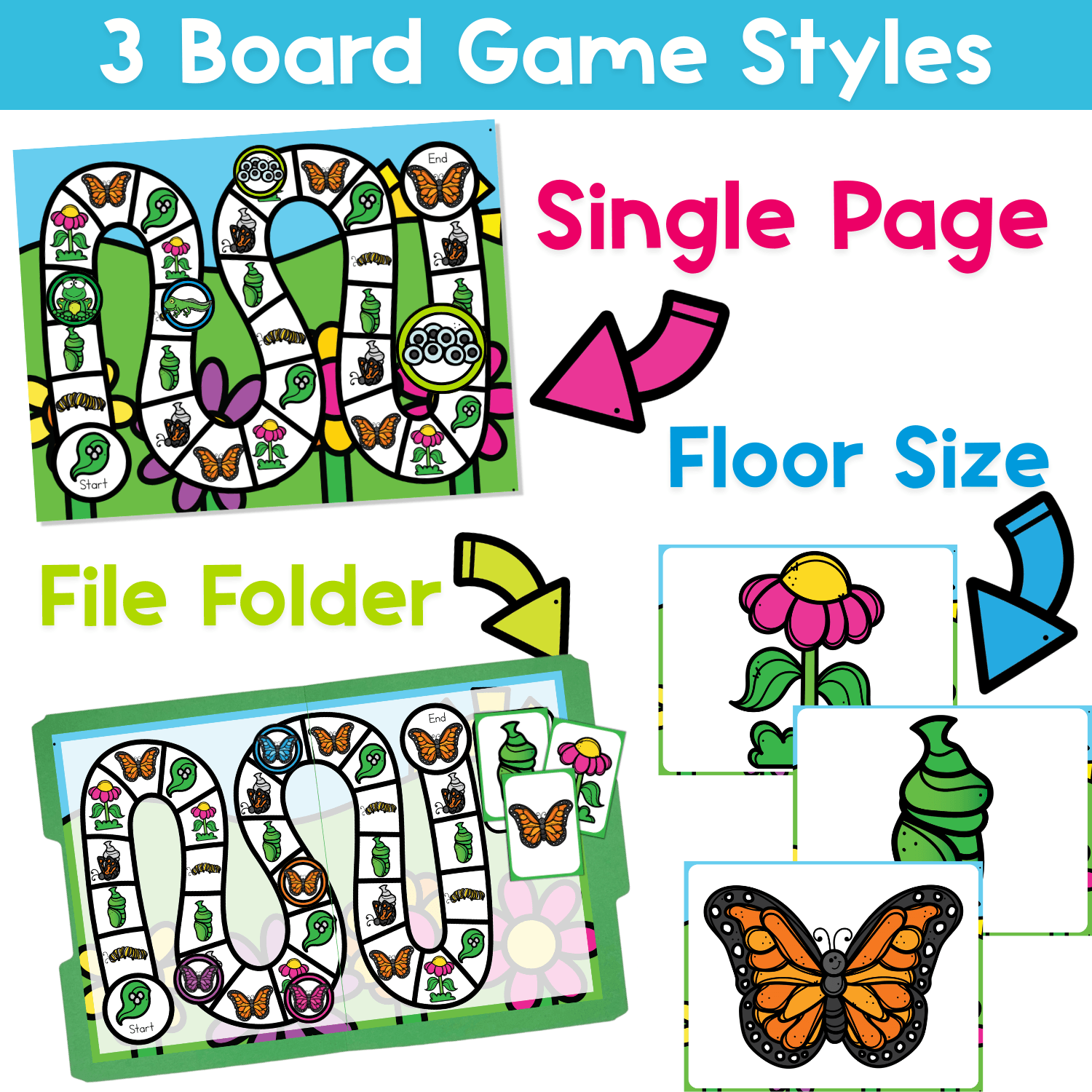
Three Ways to Play
- Single page version: one board and one page of cards for quick table play.
- File folder version: board pieces you glue inside a file folder, plus game pieces kids can color and a folder label.
- Extra large floor version: full-page life cycle pictures you tape to the floor to make a path of any shape. Kids stand on the spaces.
Every version comes in color and black and white.
How to Play the Butterfly Life Cycle Board Game
- Print the board you want and 3 copies of the cards. Cut the cards apart, shuffle them and place them face down.
- Each player puts a game piece on Start. For the floor version, players stand at the start.
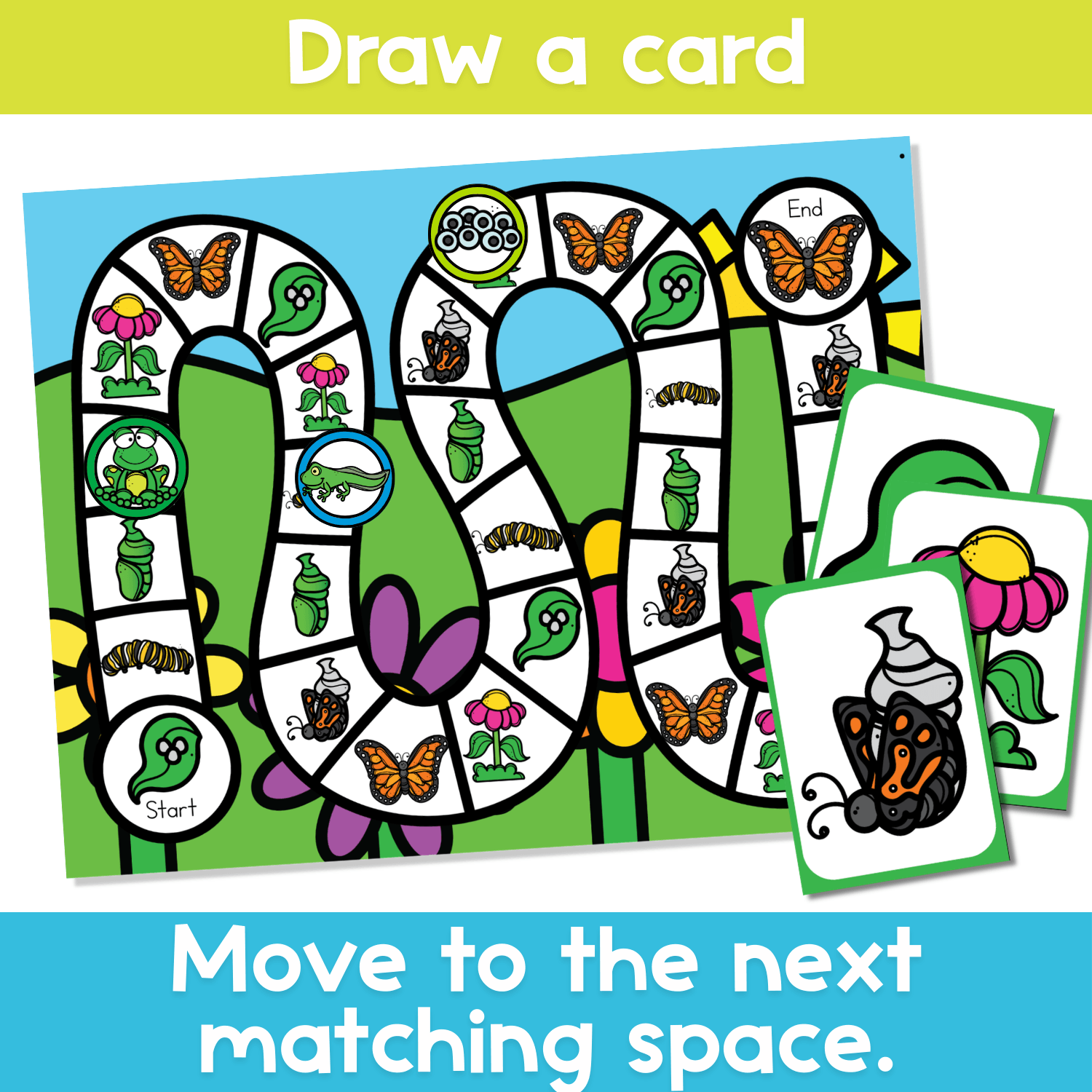
- On your turn, draw a card and move forward to the next space with that picture.
- If you draw a flower, move to the closest flower, even if it’s behind you.
- You can only land on the last butterfly with a butterfly card. The first player to reach it wins.
Small Group: Play the file folder version with 2 to 4 players and name each stage on every turn.
Movement Break: Set up the floor path in a hallway or gym and let kids walk, hop or “flutter” to each space.
Tips for Success
- Teach the stages with a book or real photos before the first game, so kids know what each picture means.
- Use 2 or 3 players. With more players, kids wait too long between turns.
- Keep the cards in the folder or a zipper bag taped inside so the game is always ready.
Easy Ways to Differentiate the Butterfly Life Cycle Board Game
During a butterfly unit, you might have a three-year-old who just learned the word “caterpillar,” a child who knows the stages but not their order and a kindergartner ready to explain metamorphosis. Talking about each card and choosing the board size let each child play and learn at the right level.
For Children Who Need More Support
- Before playing, line up one card of each stage in order and name them together. Seeing all the stages first gives kids a map for the game.
- Play cooperatively and move one shared game piece together. Without a race, kids can focus on matching pictures and naming stages.
- Take out the flower cards for the first few games. Moving backward can be frustrating for young kids, and the life cycle cards keep the focus on matching.
- Say the stage name every time a card is drawn, like “chrysalis!” Hearing the word over and over builds vocabulary.
For On-Level Practice
- Have kids name the stage on their card before they move. Saying the word on every turn builds science vocabulary.
- After moving, ask “What comes next?” Thinking about the next stage builds sequencing.
- Play the full game with flower cards. Moving back to a flower adds strategy and keeps the game exciting.
- Have kids put the five stage cards in order at the end of the game. Ordering the cards shows they know the cycle.
For an Extra Challenge
- Have kids tell one fact about their stage on every turn, like “The caterpillar eats leaves.” Sharing facts turns the game into a science talk.
- Use the word “metamorphosis” and have kids explain what changes. Explaining change is a big step in science thinking.
- Have kids draw and label the four main stages on paper after the game, without looking at the cards. Drawing on their own shows what they learned.
- Compare the butterfly life cycle with a frog or chicken life cycle. Comparing cycles shows kids how animals grow and change.
For Speech, OT, ELL or Special Education Support
- Gross motor: use the floor version and add a movement for each stage, like curling up for an egg or flapping arms for a butterfly. Moving like each stage helps kids remember the order.
- Speech: practice multisyllable words like caterpillar and chrysalis by clapping each part. Breaking words into syllables makes them easier to say.
- ELL: say each stage name as you point to the picture and have kids repeat it. The clear pictures show the meaning of new science words.
- Fine motor: have kids color the game pieces from the file folder version and cut them out. Coloring and cutting a small piece builds hand control.
Life Cycle Board Game: Butterflies Is Perfect For:
- Preschool and pre-K
- Kindergarten
- Butterfly and insect units
- Spring science
- Science centers and small groups
- Gross motor and indoor recess
- Homeschool science
- Speech therapy and OT sessions
- ELL and multilingual learners


