Roll and Count Math Activity: Watermelon Theme
Recommended Grade Level:
Type of Resource: PDF
Number of Pages: 3

Coordinating Activities


Watermelon Roll and Count Math Activity
- 1 Roll It, Write It, Show It mat
- Each mat includes:
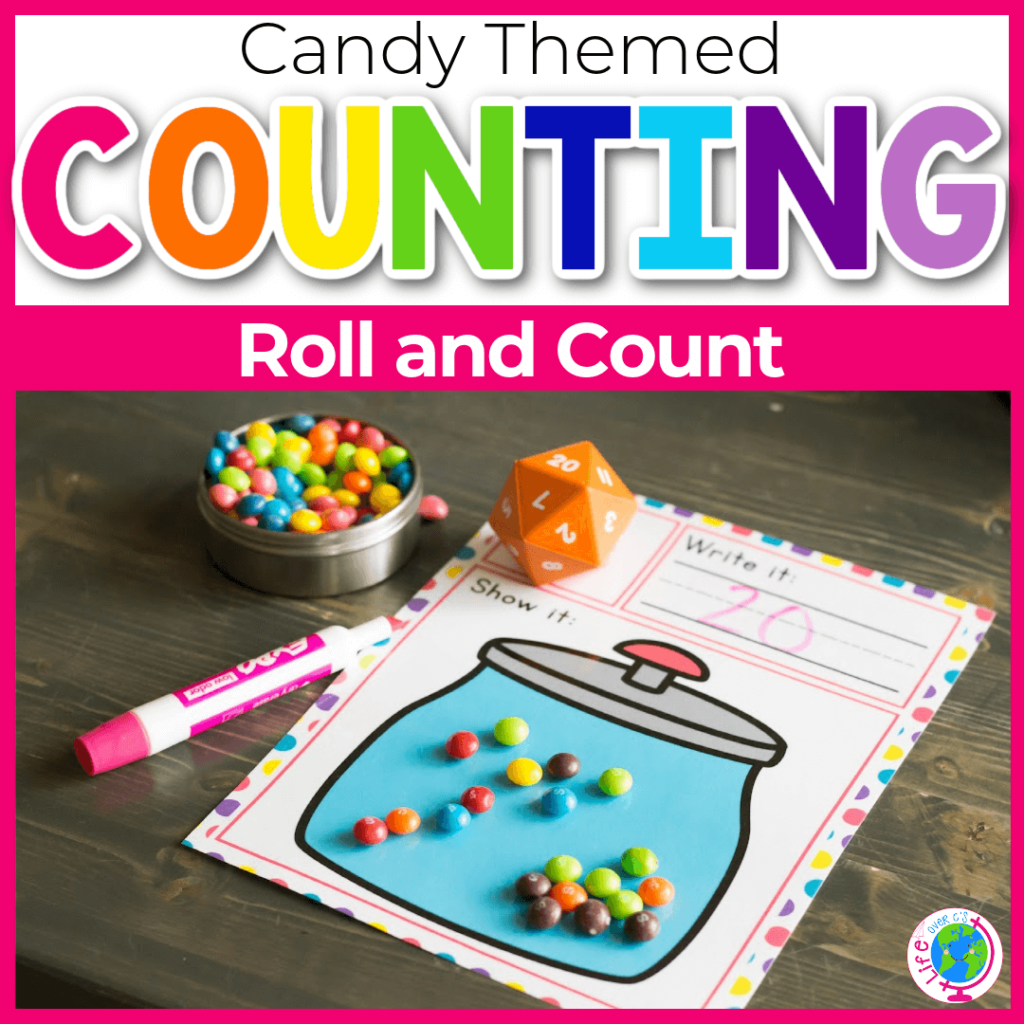
- A Roll it box to draw the dots or picture rolled
- A Write it box to write the number
- A Show it picture of the watermelon slice for building the set
Print in color and laminate the mat so kids can write on it with a dry-erase marker.
Required Materials:
- Paper, Printer, Ink
- Laminator (recommended so the mat lasts)
- Die (numbers or dots 1 to 6)
- Dry-erase marker
- Seeds or dried black beans
Standards for Counting and Cardinality
This Watermelon roll and count activity supports early math standards connected to writing numbers, counting objects, one-to-one correspondence and matching numbers to amounts.
Common Core State Standards: Mathematics
- CCSS.MATH.CONTENT.K.CC.A.3: Write numbers from 0 to 20 and represent a number of objects with a written numeral. Kids write the number they roll in the Write it box.
- CCSS.MATH.CONTENT.K.CC.B.4: Understand the relationship between numbers and quantities. Kids connect the number they roll to a set of seeds or dried beans.
- CCSS.MATH.CONTENT.K.CC.B.5: Count to answer “how many?” questions. Kids count the seeds or dried beans on the mat to answer how many.
Texas Prekindergarten Guidelines and TEKS for Mathematics
- PK4.V.A.2: Children count up to 10 objects with one-to-one correspondence. Kids place one seed at a time as they count.
- PK4.V.A.3: Children count up to 10 items and show that the last number counted tells how many are in the set.
- TEKS K.2C: Count a set of objects and show that the last number said tells how many are in the set.
Virginia Mathematics Standards of Learning
- K.NS.1.a: Use one-to-one correspondence to find how many are in a set. Kids place one seed at a time as they count.
- K.NS.2.b: Build a set of objects to match a given numeral. Kids build a set of seeds or dried beans to match the number they rolled.
Watermelon Roll and Count Math Activity helps preschool and kindergarten kids roll a number, write it and count out a matching set with a hands-on printable math activity.
Add the seeds! Kids roll a die and place that many seeds on the watermelon slice.
The mat has three parts. Kids roll the die and draw what they see in the Roll it box, write the number in the Write it box and then show it by placing that many seeds or dried beans on the watermelon slice.
Moving from dots to a written number to a set of real objects helps kids connect each number to the amount it stands for.
Laminate the mat and use a dry-erase marker so kids can roll and count again and again.
Keep the mat in a math tub with a die, a dry-erase marker and a cup of seeds or dried beans for a quick math center.
How to Use Watermelon Roll and Count Math Activity
- Roll the die and count the dots.
- Draw the dots in the Roll it box.
- Write the number in the Write it box.
- Count out that many seeds or dried beans and place them on the watermelon slice.
- Wipe the mat clean and roll again.
Small Group: Give each child a mat. Take turns rolling one die for the group, then everyone writes the number and shows it on their own mat.
Independent Practice: Set the mat in a math center with a die, a dry-erase marker and a cup of seeds or dried beans. Kids roll, write and show as many times as they like.
Easy Ways to Differentiate This Roll and Count Activity
Some kids are still learning to count dots on a die, some can count but need help writing the number and some are ready to add. On this watermelon mat, kids roll, write the number and add that many seeds to the slice.
For Children Who Need More Support:
- Start with a die that has only 1, 2 and 3 dots. Small rolls build success.
- Have kids place one black bean seed on the watermelon for each dot they touch. A seed for each dot keeps counting accurate.
- Count the seeds together, touching each one. Counting together models a steady pace.
- Help kids copy the dots into the Roll it box. Drawing the dots helps kids learn the patterns.
For On-Level Practice:
- Have kids roll, write and add the seeds on their own. Doing every step shows progress.
- Have kids line the seeds up in a row along the rind after counting. A straight row is easy to recount.
- Have kids name the roll quickly before counting. Naming patterns builds number sense.
- Play with a partner who checks the seeds. Partners keep each other careful.
For an Extra Challenge:
- Roll two dice and add the total number of seeds. Combining rolls builds addition.
- Have kids take a pretend bite and remove some seeds, then tell how many are left. Taking away builds subtraction.
- Roll twice and compare which slice has more seeds. Comparing builds number sense.
- Use a 12-sided die so kids add more seeds. Bigger numbers stretch strong counters.
For Speech, OT, ELL or Special Education Support:
- For speech practice, use the w sound in watermelon and the s sound in seeds. Theme words give focused practice.
- For OT practice, have kids draw seeds with a black marker on a paper copy of the mat. Drawing small dots builds pencil control.
- For ELL support, teach watermelon, seed, slice and summer before playing. Theme words help kids join in.
- For special education support, keep the seeds in a bottle cap next to the mat. A small cap holds tiny pieces in one place.
Watermelon Roll and Count Math Activity Is Perfect For:
- Preschool and pre-K
- Kindergarten
- ELL and multilingual learners
- Summer and picnic themes
- Math centers
- Morning tubs
- Small-group instruction
- Intervention
- Special education
- Speech, OT and early intervention sessions
- Homeschool preschool and kindergarten
- Substitute plans