I Spy “Flip” Board Game: Fall Shapes
Recommended Grade Level:
Type of Resource: PDF
Number of Pages: 21

You must be an Annual or Forever Member to Access this Resource.
Join the Life Over C’s Club to Access

Already a member? Login below:





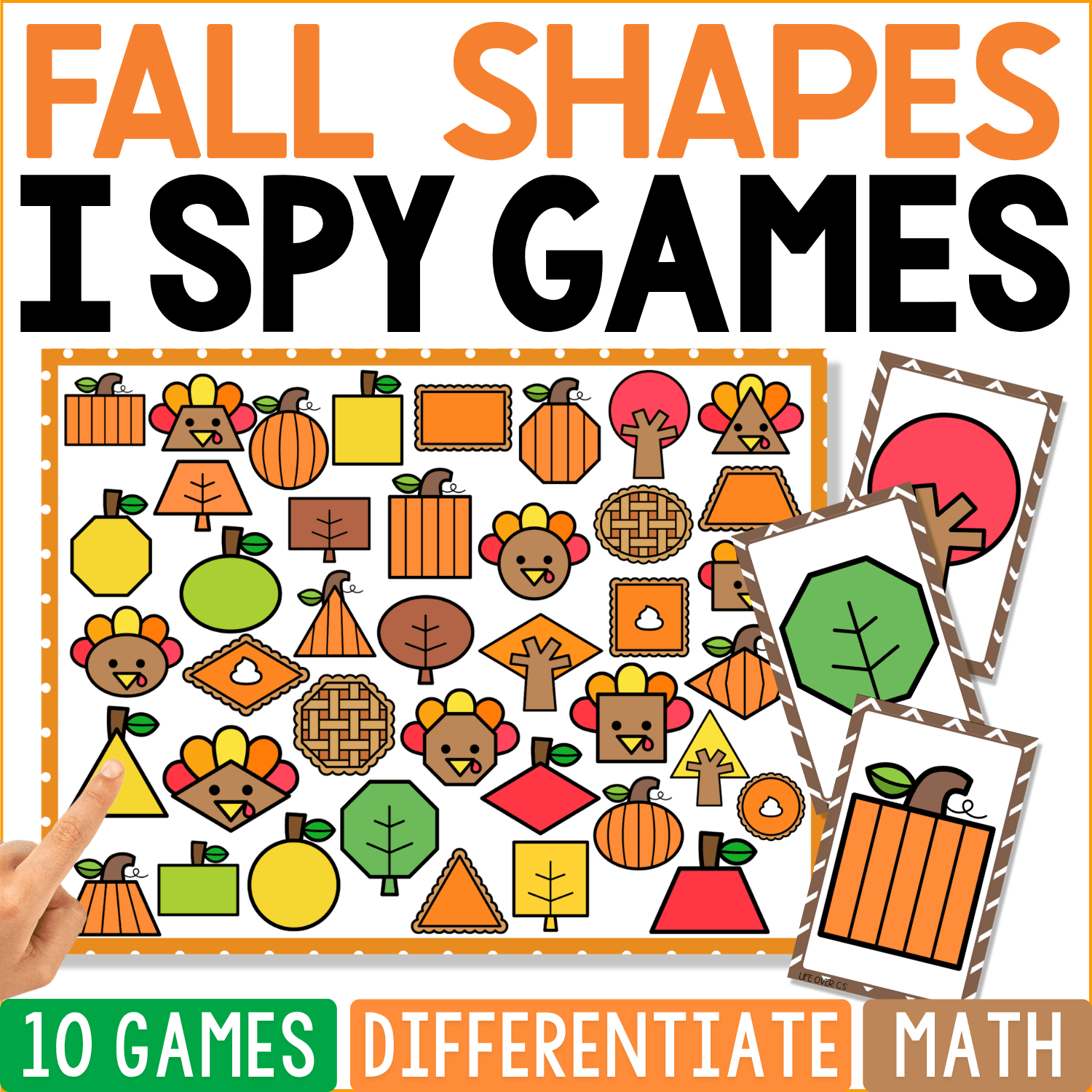
Fall Shapes I Spy “Flip” Board Game
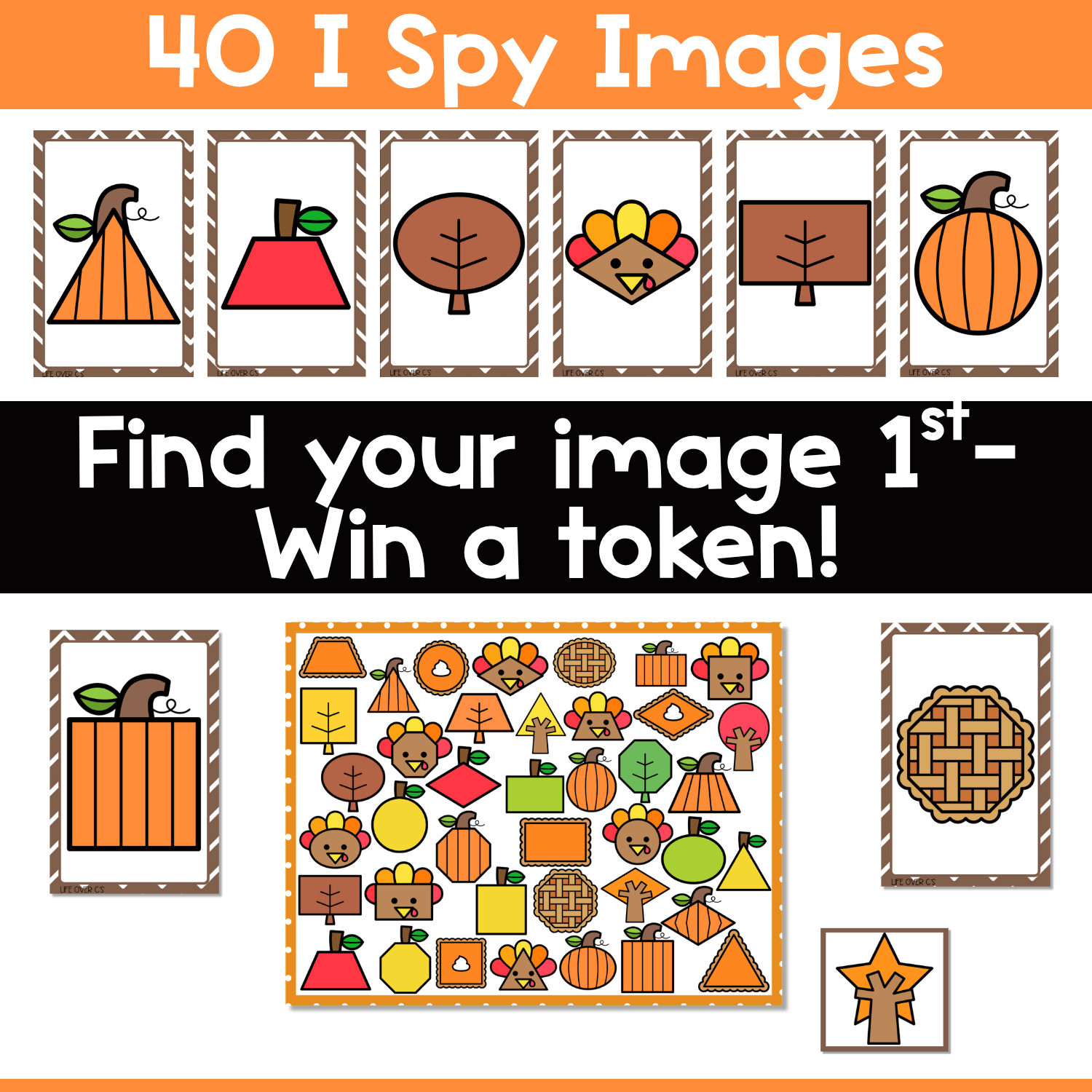
- 40 I Spy shape cards, 8 to a page (pumpkins, turkeys, apples, leaves and pies drawn as shapes)
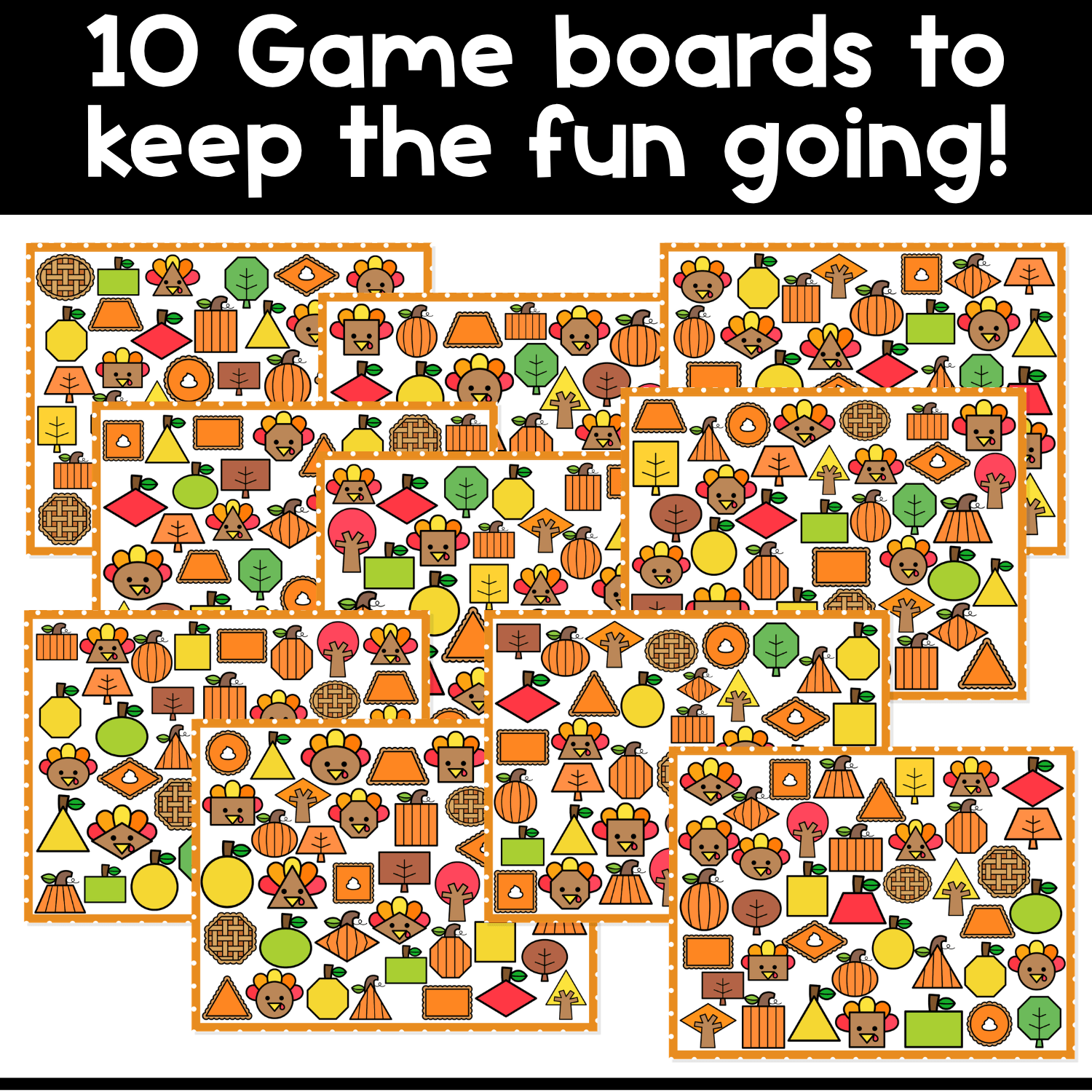
- 10 full-color I Spy game boards
- 1 page of 20 star tokens
- Table of contents and preparation directions
- I Spy “Flip” game instructions
Each fall picture comes in more than one shape, like a pumpkin drawn as a circle, an octagon and a triangle, so kids have to look at the shape, not just the picture.
Required Materials:
- White cardstock, printer and ink
- Laminator
- Paper cutter or scissors
- Optional: mini erasers or counters to use as tokens
Standards for 2D Shapes and Geometry
This fall shapes I Spy game supports early math standards connected to naming shapes, describing shapes and recognizing shapes in different sizes and positions.
Common Core State Standards: Mathematics
- CCSS.MATH.CONTENT.K.G.A.1: Describe objects in the environment using names of shapes. Kids name the shape on each card.
- CCSS.MATH.CONTENT.K.G.A.2: Correctly name shapes regardless of their orientations or overall size. The shapes appear in different sizes, colors and positions.
Texas Prekindergarten Guidelines and TEKS for Mathematics
- PK4.V.C.1: Child names and describes common 2D shapes and names at least 1 solid 3D shape. Kids name each shape they find.
- PK4.V.C.4: Child recognizes common shapes, regardless of orientation and size. The board shows each shape in new spots and sizes.
- TEKS K.6(A): Identify two-dimensional shapes, including circles, triangles, rectangles and squares as special rectangles. Kids find these shapes and more.
Virginia Mathematics Standards of Learning
- K.MG.2: Identify, describe, name, compare and construct plane figures (circles, triangles, squares and rectangles). Kids name and describe the shapes they find.
The Fall Shapes I Spy “Flip” Board Game gives preschool and kindergarten kids hands-on practice naming 2D shapes using 40 cards and 10 colorful game boards.
Flip a card and find the octagon pumpkin! Kids race to spot fall pictures drawn as shapes on a busy I Spy board.
The cards show circles, squares, rectangles, triangles, trapezoids, rhombuses and octagons. Each fall picture comes in more than one shape, like a pumpkin drawn as a circle, an octagon and a triangle, so kids have to look closely at the shape to find the exact match.
Kids talk about sides and corners as they search, which builds shape vocabulary in a natural way.
With 10 different game boards, the cards land in new spots each round. That keeps the search fresh while kids build shape recognition, visual scanning and attention to detail.
How to Play the Fall Shapes I Spy Game
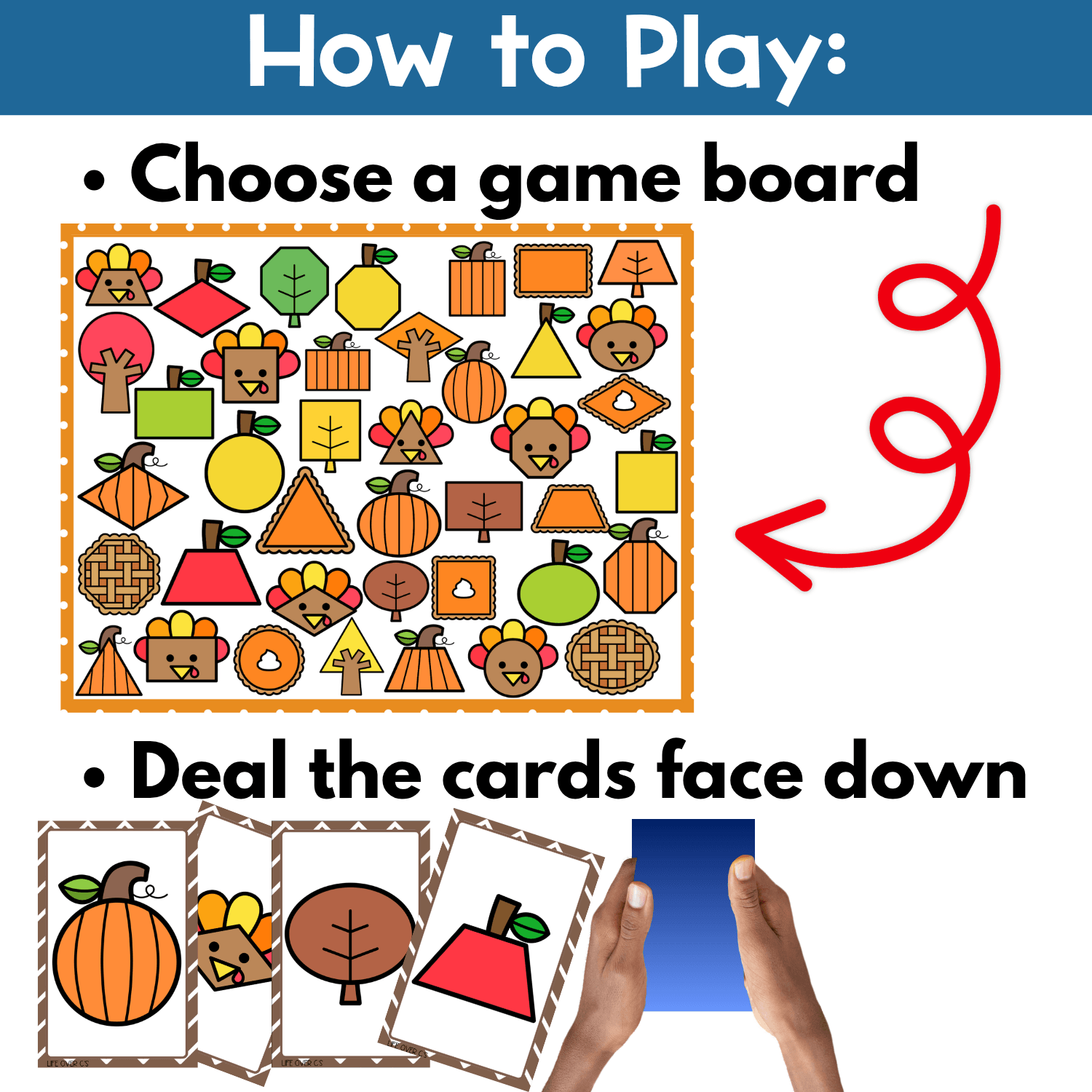
- Choose one I Spy game board and place it where every player can see it. Deal the picture cards face down so each player has a small stack.
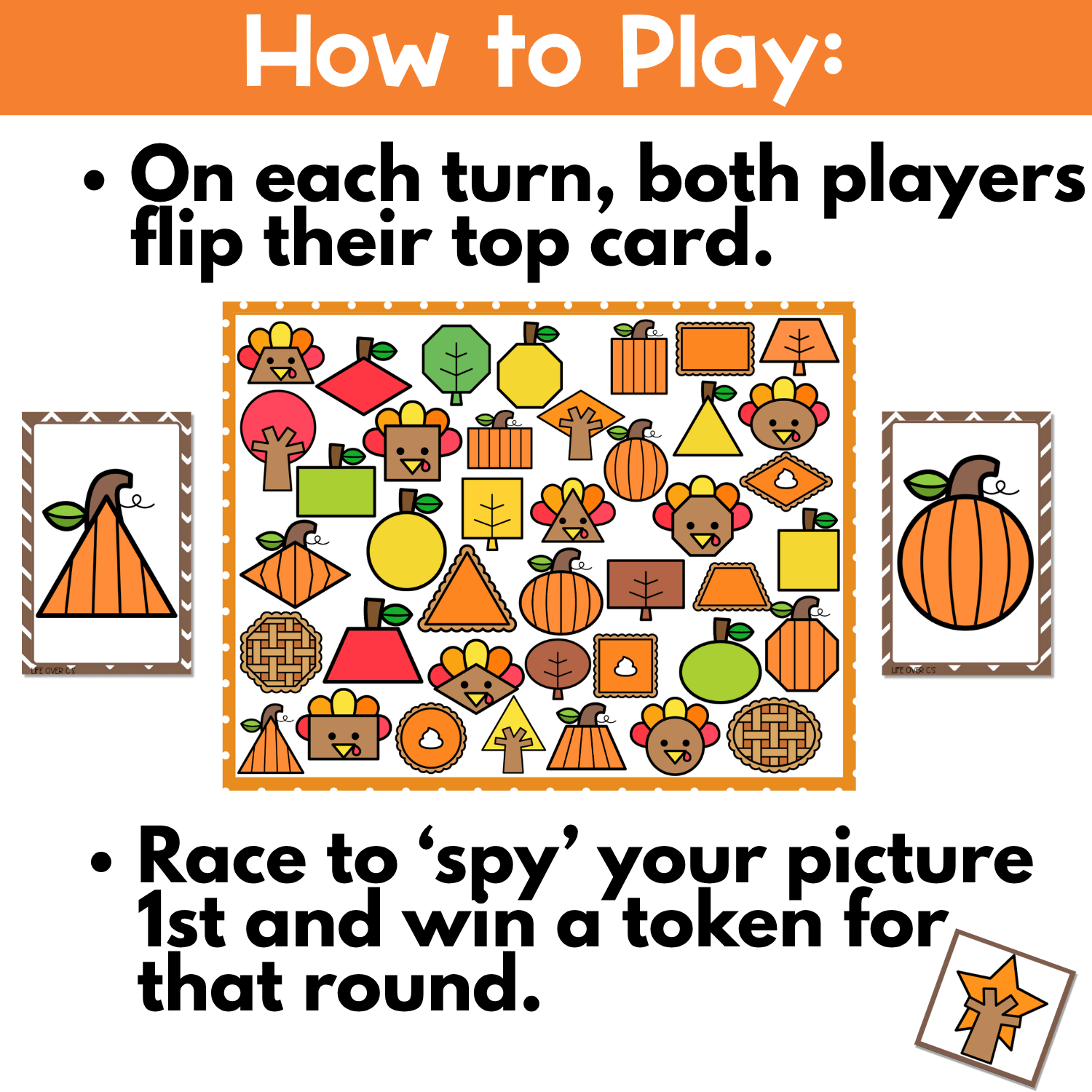
- All players flip their top card at the same time and race to find the matching picture on the board.
- The first player to point to the right picture names the shape, then wins a star token or keeps the card as a point. Play until every card is flipped. The player with the most points wins!
Cooperative Play: Put the picture cards in one shared pile. Kids take turns flipping a card and work together to find it on the board. Cover each match with a token to see how many matches the group can find.
Independent Play: Set one board and a stack of cards in a math center. Kids flip one card at a time, find the picture and name the shape aloud. Covering each picture with a token or mini eraser adds a little fine motor practice.
Easy Ways to Differentiate This Fall Shapes I Spy Game
Pumpkins, turkeys, apples, leaves and pies are drawn as circles, octagons, triangles and more on these fall cards. Some kids will match the picture, some will name the shape and some will explain how the shapes are different. The cozy fall pictures make shape practice feel like part of the season.
For Children Who Need More Support:
- Begin with the circle pumpkins and apples. Round fall objects match the shape kids learn first.
- Bring in a real apple and a real leaf and compare their shapes to the cards. Real objects make the shapes concrete.
- Use a color hint, like “orange circle.” A second clue narrows the search.
- Search one corner of the board at a time. A small area keeps the search successful.
For On-Level Practice:
- Find all the leaves on the cards and name each one’s shape. One object in many shapes shows that shape is the focus.
- Sort fall cards into shapes with three sides, four sides and more. Sorting by sides builds geometry language.
- Count the sides on each shape after you find it. Counting connects shapes to numbers.
- Find a fall object outside that matches a card shape. Nature walks extend the game.
For an Extra Challenge:
- Compare the octagon pumpkin to a real pumpkin and explain what is different. Real versus drawn shapes builds reasoning.
- Make a fall picture using four different shapes and name each one. Combining shapes builds spatial skills.
- Give a clue like “three sides and three corners” for a partner to find a triangle. Clue-giving uses attribute words.
- Make a shape graph with the cards from one board. Graphing adds data.
For Speech, OT, ELL or Special Education Support:
- Speech: practice /f/ in fall and /l/ in leaf. Choose cards that fit the child’s goal.
- Fine motor: trace each shape on a real leaf with a crayon after the game. Tracing builds hand control.
- ELL: teach fall words and shape names together, like “circle apple.” Pairing words helps English learners remember both.
- Visual support: cover all but one row of the board with paper. A smaller area helps kids find shapes in busy pictures.
Fall Shapes I Spy Game Is Perfect For:
- Preschool and pre-K
- Kindergarten
- Fall themes
- Math centers
- Small-group instruction
- Special education
- Speech and language therapy
- ELL and multilingual learners
- Homeschool
- Early finishers