Fine Motor Mats Geoboard: Winter
Recommended Grade Level:
Type of Resource: PDF
Number of Pages: 19




Winter Geoboard Mats
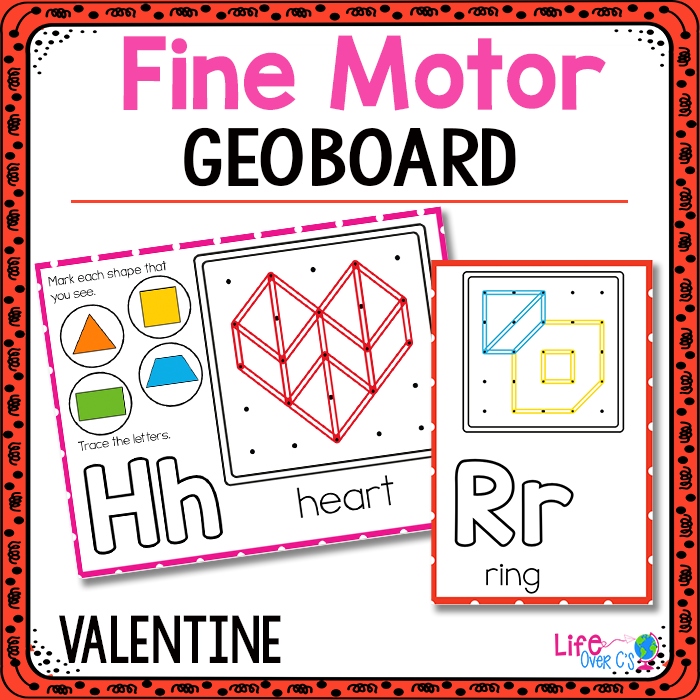
- Set 1: 10 full-page geoboard mats. Each one has a color geoboard picture to copy, a “Mark each shape that you see” box with a triangle, square, rectangle and trapezoid, uppercase and lowercase letters to trace and the picture word.
- Set 2: 10 half-page geoboard mats, two to a page, with simpler pictures, a large outline letter pair and the picture word.
- Pictures: snowman, hat, snowflake, sled, nut, mitten, cocoa and tree (the snowflake and tree each appear on two mats).
Laminate the full-page mats so kids can mark shapes and trace letters with a dry-erase marker.
Required Materials
- A geoboard with 5 rows of 5 pegs (the mats match this size)
- Geoboard rubber bands in several colors
- Laminator or sheet protectors
- Dry-erase marker for marking shapes and tracing letters
- Scissors or a paper cutter for the half-page mats
- Paper, printer and ink
Standards for Shapes, Letters and Fine Motor Skills
These winter geoboard mats support early standards for naming and building shapes, recognizing and printing letters and using small hand muscles with control.
Common Core State Standards: Mathematics
- CCSS.MATH.CONTENT.K.G.A.2: Correctly name shapes regardless of their orientations or overall size. Kids find and mark the triangle, square, rectangle and trapezoid in each picture.
- CCSS.MATH.CONTENT.K.G.B.5: Model shapes in the world by building shapes from components. Kids build the snowman, mitten and snowflake with rubber bands stretched between pegs.
Common Core State Standards: English Language Arts
- CCSS.ELA-LITERACY.RF.K.1.D: Recognize and name all upper- and lowercase letters of the alphabet. Each mat pairs a picture with its uppercase and lowercase letter.
- CCSS.ELA-LITERACY.L.K.1.A: Print many upper- and lowercase letters. Kids trace both letters on the full-page mats.
Texas Prekindergarten Guidelines and TEKS
- PK4.V.C.2: Child creates shapes using materials and/or manipulatives. Kids create each picture with geoboard bands.
- PK4.V.C.4: Child recognizes common shapes, regardless of orientation and size. Kids spot shapes turned different ways inside the pictures.
- PK4.III.C.1: Child recognizes and names at least 20 letters. Kids name the letter on each mat as they trace it.
- PK4.IX.B.1: Child shows control of tasks that require small-muscle strength and control. Stretching and hooking bands builds finger and hand strength.
- PK4.IX.B.2: Child shows increasing control of tasks that require eye-hand coordination. Kids match each band to the right pegs on the board.
- TEKS K.6(A): Identify two-dimensional shapes, including circles, triangles, rectangles and squares as special rectangles. Kids identify the shapes they mark on each picture.
Virginia Mathematics Standards of Learning
- K.MG.2.a: Identify and name circles, triangles, squares and rectangles in concrete and pictorial forms, regardless of orientation. Kids name the shapes in the mat pictures.
- K.MG.2.f: Construct these figures using materials such as straws, sticks or pipe cleaners. Kids construct shapes on the geoboard with rubber bands.
Virginia English Standards of Learning
- K.FFR.3.A: Identify and name the uppercase and lowercase letters of the alphabet. Kids name the letter pair on each mat.
These winter geoboard mats let preschool and kindergarten kids build snowmen, mittens and snowflakes with rubber bands while they practice shapes, letters and fine motor skills.
Grab your mittens… actually, wait. Kids will need their fingers for this one! They copy cozy winter pictures onto a geoboard by stretching rubber bands across the pegs.
Each picture sits on a 5-by-5 peg grid with colored lines to follow. Kids work one line at a time so a snowman or a cup of cocoa comes together band by band.
Set 1 has 10 full-page mats with detailed pictures, a shape box for marking the triangle, square, rectangle and trapezoid and letters to trace. Set 2 has the same pictures as half-page mats with simpler designs. The snowflake and the tree each appear on two mats, which makes a great compare-and-contrast moment.
Winter often means more indoor recess and less outdoor play. Geoboards keep hands busy and minds working when everyone’s stuck inside.
Stretching a band takes a surprising amount of finger strength. Kids who tire out holding a crayon often love geoboards because the stretch-and-hook motion feels like play while it builds the very same muscles.
The Winter Pictures
Here’s what kids build, with the letter pair on each mat:
- Snowman (Ss)
- Hat (Hh)
- Snowflake (Ss)
- Sled (Ss)
- Nut (Nn)
- Mitten (Mm)
- Cocoa (Cc)
- Tree (Tt)
How to Use Winter Geoboard Mats
- Pick a winter picture and set it beside the geoboard.
- Copy each colored line with a rubber band until the board matches the mat.
- Mark the shapes and trace the letters with a dry-erase marker.
Small Group: Build the snowman together, starting at the bottom and working up. Talk about the shapes in each part of his body.
Independent Practice: Keep the mats in a winter fine motor tub for January and February.
Tips for Smooth Geoboard Time
- White and blue bands give the pictures a snowy look.
- Store the bands in a mitten for a fun winter center container.
- Laminate the full-page mats. Winter mats get plenty of use in January and February.
Easy Ways to Differentiate These Winter Geoboard Mats
Some kids are still building hand strength while others are ready to copy a detailed snowflake.
For Children Who Need More Support:
- Start with the mitten half-page mat. It has fewer lines and a familiar shape.
- Have the child kneel at a low table so they can see the whole board from above.
- Build the snowman’s body first, then add the hat. Breaking a picture into parts keeps it from feeling like too much.
- Model the first band with a slow, exaggerated stretch. Kids see how far a band can go without snapping.
For On-Level Practice:
- Build both snowflakes and talk about how they’re different. Even pictures with the same name can look different.
- Trace Ss on the snowman, snowflake and sled mats. Three pictures, one letter!
- Build the cocoa and mark each shape you see. Then point to each shape on the board too.
For an Extra Challenge:
- Build the sled, then add a snowman riding on it. Kids have to plan where the snowman can sit.
- Add bands to the tree to decorate it with your own design. There’s no wrong way to decorate a tree.
- Build a snowman and a snowflake on one large board to make a winter scene. Kids plan the space so both fit.
For Speech, OT, ELL or Special Education Support:
- OT: Use heavier bands for extra resistance after recess. Pulling against resistance helps many kids feel calm and focused.
- Speech: Practice /s/ blends with snowman, snowflake and sled.
- ELL: Act out winter words like shiver, sled and sip before building.
- Special education: Let the child choose the band color for each line. Making choices keeps kids engaged.
Perfect For
- January and February fine motor centers
- Indoor recess bins
- OT sessions
- Homeschool winter learning
- Small groups