Fine Motor Mats: Bricks: Clothing
Recommended Grade Level:
Type of Resource: PDF
Number of Pages: 15

You must be an Annual or Forever Member to Access this Resource.
Join the Life Over C’s Club to Access

Already a member? Login below:
Coordinating Activities




Fine Motor Mats: Bricks: Clothing
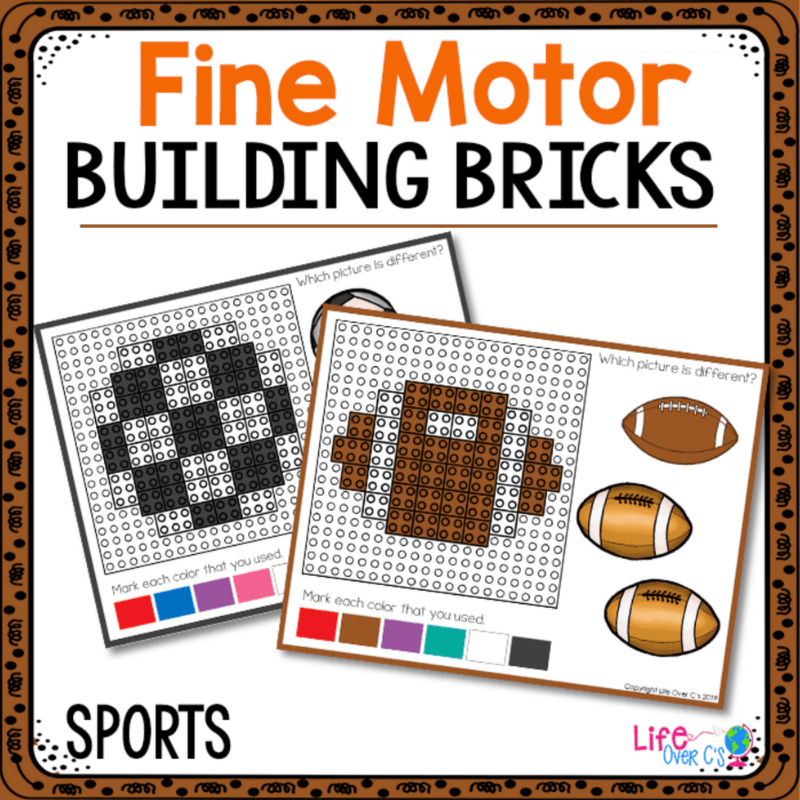
- 10 clothing building brick mats in color
- Each mat shows a brick picture to build, 3 small pictures to compare and a color key
- “Which picture is different?” on every mat
Print in color and laminate so kids can mark the color key with a dry-erase marker.
Required Materials:
- Paper, Printer, Ink
- Laminator
- Building bricks (small, flat bricks in the colors on each mat)
- Dry-erase marker
Standards for Fine Motor and Visual Skills
Building brick pictures gives kids practice with small-muscle control, matching colors and noticing what is the same and different.
Common Core State Standards: Mathematics
- CCSS.MATH.CONTENT.K.MD.B.3: Classify objects into given categories and count the number of objects in each category.
Texas Prekindergarten Guidelines
- PK4.IX.B.1: Child shows control of tasks that require small-muscle strength and control.
- PK4.IX.B.2: Child shows increasing control of tasks that require eye-hand coordination.
- PK4.V.E.1: Child sorts objects that are the same and different into groups and uses language to describe how the groups are similar and different.
Fine Motor Mats: Bricks: Clothing are building brick mats that help preschool and kindergarten kids strengthen little fingers while they match colors and build clothing pictures one brick at a time.
Look, match and build! Each mat shows a clothing picture made of brick squares, like a dress, a sock, a hat, a shirt, a t-shirt and a boot. Kids find a small, flat brick that matches each square and set it on its square until the whole picture is built.
Picking up small bricks and lining them up on the squares takes a lot of finger strength and control, the same muscles kids need for holding a pencil. Matching each color square by square also builds focus and visual tracking.
Every mat has a little extra thinking built in. Kids mark each color they used on the color key and then look at three small pictures to find the one that is different, which is great practice for noticing details.
Print the mats in color and laminate them so kids can mark the color key with a dry-erase marker and wipe it clean for the next builder.
How to Use Fine Motor Mats: Bricks: Clothing
- Choose a mat and gather a bin of small, flat building bricks.
- Find a brick that matches the color of the first square.
- Keep matching and placing bricks until the picture is complete.
- Mark each color you used on the color key with a dry-erase marker.
- Look at the three small pictures and find the one that is different.
- Take the bricks off, wipe the mat and try a new one.
Small Group: Build the same mat together and name each color as you place it. Then talk about how the three small pictures are alike and different.
Independent Practice: Place the mats and a bin of bricks in a fine motor or STEM center. Kids can build one mat each visit.
Easy Ways to Differentiate These Building Brick Mats
Some kids in your group are still building the finger strength to pick up small pieces, some can match colors but lose their place on the grid and some are ready to plan and build on their own. The mats stay the same. What changes is how much of the picture kids build, how they keep their place and what they do with the color key.
For Children Who Need More Support:
- Have kids build the bottom row of the dress mat first and work up one row at a time. Going row by row keeps them from losing their place.
- Sort the bricks for the sock mat by color into a muffin tin before starting. Sorting first means kids only think about placing.
- Give kids larger bricks for the clothing mats so pinching is easier. Bigger pieces keep frustration from ending the activity early.
- Have kids slide a finger along the row they are building on the hat mat, or cover the rows above with a sticky note. It keeps their eyes in one place.
For On-Level Practice:
- Have kids build the whole boot picture, then mark each color they used on the color key. Checking the key builds attention to detail.
- Ask kids to name the color of each brick as they place it on a clothing mat. Naming colors adds vocabulary to the building.
- On each clothing mat, have kids look at the three small pictures, tell which one is different and how they know. Explaining the difference builds visual discrimination.
- Have kids count the bricks in one color on the dress mat and compare it to another color. Comparing counts adds early math.
For an Extra Challenge:
- Have kids build the sock on a baseplate next to the mat instead of on top of it. Copying from a model to a separate space is a big visual motor step.
- Have kids count the bricks of every color on the hat mat and write the numbers next to the color key. Counting and writing fit on one mat.
- Ask kids to design their own clothing picture on grid paper for a friend to build. Designing takes planning and spatial thinking.
- Time a build of the boot mat, then try to beat it the next day. Speed and control grow together.
For Speech, OT, ELL or Special Education Support:
- Watch how kids pick up bricks on the clothing mats. A whole-hand grab instead of a pinch may mean they need bigger pieces or a quick warm-up.
- Use the clothing mats for two-handed work: one hand holds the mat steady while the other places bricks. Using both hands together builds coordination.
- Practice position words while building the dress: top, bottom, next to, above and below. Real building makes the words concrete.
- For multilingual learners, name each clothing picture and its colors together before building, plus words like sleeve, collar and heel. Theme words give kids more to talk about.
Fine Motor Mats: Bricks: Clothing Are Perfect For:
- Preschool and pre-K
- Kindergarten
- Fine motor centers
- STEM bins
- Morning tubs
- Early finishers
- Indoor recess
- Occupational therapy sessions
- Special education
- Early intervention
- ELL and multilingual learners
- Homeschool preschool
You must be an Annual or Forever Member to Access this Resource.
Join the Life Over C’s Club to Access
Already a member? Login below: