
Alphabet Matching Game: Valentine’s Day
Recommended Grade Level:
Type of Resource: PDF
Number of Pages: 54

Coordinating Activities



Alphabet Matching Game: Valentine’s Day
- 26 foldable envelopes, one for each uppercase letter A-Z
- 78 uppercase heart cards (3 for each letter)
- 78 lowercase heart cards (3 for each letter)
- Color and black and white versions
- Directions for folding the envelopes
Print in color for a bright center or in black and white so kids can color the hearts.
Required Materials:
- Paper, Printer, Ink
- Scissors
- Tape or glue sticks
Standards for Alphabet Knowledge and Phonics
Sorting the hearts gives kids repeated practice recognizing uppercase and lowercase letters and pairing the two forms.
Common Core State Standards: English Language Arts
- CCSS.ELA-LITERACY.RF.K.1.D: Recognize and name all upper- and lowercase letters of the alphabet.
- CCSS.ELA-LITERACY.RF.K.3.A: Demonstrate basic knowledge of one-to-one letter-sound correspondences.
Texas Prekindergarten Guidelines and TEKS for English Language Arts and Reading
- PK4.III.C.1: Child recognizes and names at least 20 letters.
- PK4.III.C.2: Child recognizes at least 20 distinct letter-sound correspondences.
- TEKS ELA K.2(D)(v): Demonstrate print awareness by identifying all uppercase and lowercase letters.
Virginia English Standards of Learning
- K.FFR.3.A: Identify capital and lowercase letters of the alphabet.
- K.FFR.3.B: Identify common letter-sound correspondences.
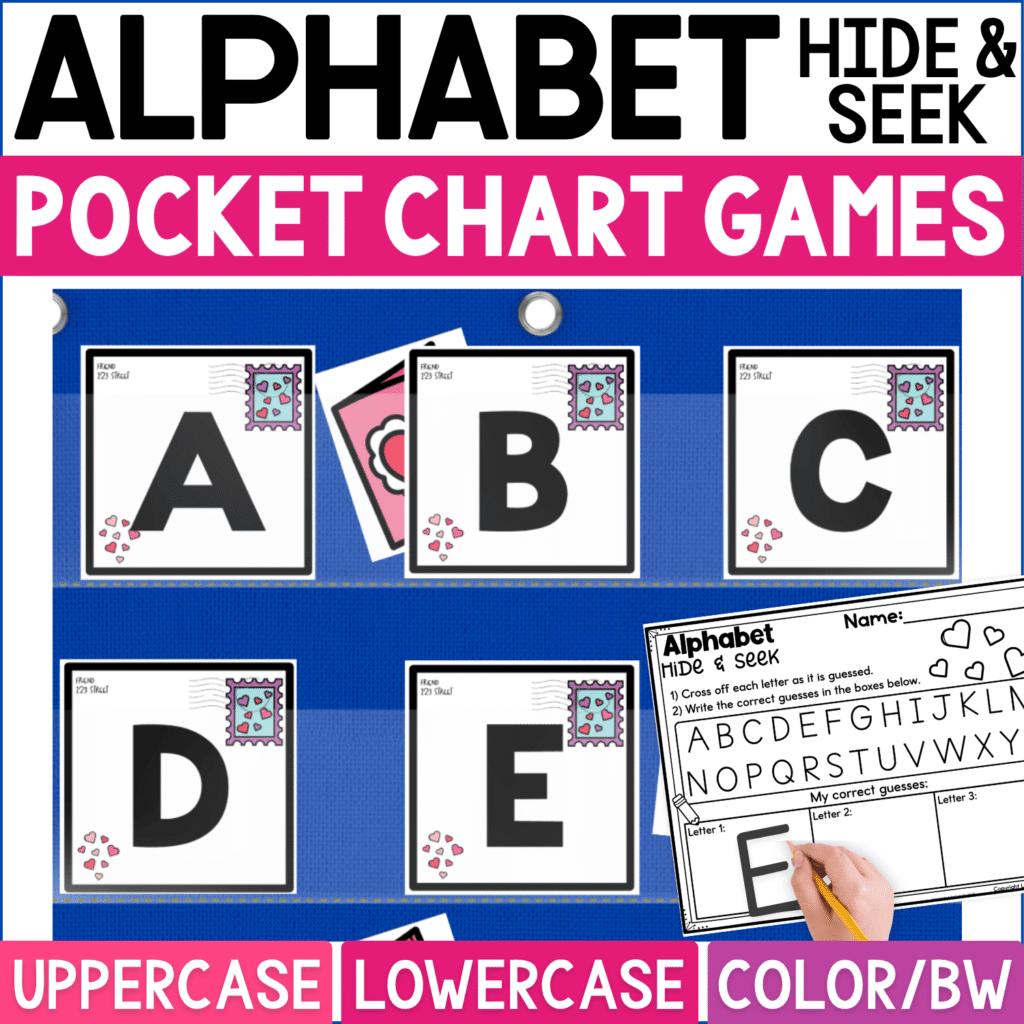
Alphabet Matching Game: Valentine’s Day is a letter mailbox game that has preschool and kindergarten kids sort uppercase and lowercase heart cards into letter envelopes.
Deliver the valentines! The set has 26 foldable envelopes, one for each uppercase letter, and 78 uppercase and 78 lowercase heart cards, with 3 of each letter. Kids read each heart and put it in the matching envelope.
Sorting both forms of a letter into one envelope helps kids see that A and a belong together. Having 3 hearts for each letter means lots of practice.
Use a few envelopes at a time for letter of the week or set out the whole alphabet for review.
Color and black and white versions are included, plus directions for folding the envelopes.
How to Use Alphabet Matching Game: Valentine’s Day
- Print the envelopes and hearts, then fold the envelopes.
- Choose a few envelopes to set out.
- Pick a heart and name the letter.
- Find the envelope with the matching letter.
- Put the heart in the envelope and say the letter sound.
Small Group: Deliver hearts together and say each letter sound.
Independent Practice: Put a few envelopes and their hearts in a February literacy center.
Easy Ways to Differentiate This Valentine’s Day Letter Game
Some kids in your group are still learning letter names, some know the letters but not their sounds and some are ready to read and write words. The 26 envelopes and 156 hearts stay the same. What changes is how many envelopes are open and which hearts kids sort.
For Children Who Need More Support:
- Start with three envelopes for letters the child already knows. Familiar letters let them learn the “mail delivery” routine first.
- Sort only the uppercase hearts at first. They match the letter on the envelope exactly, so kids are matching shapes, not two forms of a letter.
- Name each letter together before kids deliver the heart.
- Hold up a heart and offer two envelopes: “Does this go to A or to M?” A choice of two is easier than scanning every envelope.
For On-Level Practice:
- Sort all six hearts for five envelopes, which is enough practice without dragging on.
- Have kids name each letter and say its sound as they deliver it, so every heart is sound practice too.
- Mix uppercase and lowercase hearts for the same envelopes so kids have to recognize both forms.
- At the end, open each envelope and check that all six hearts match. Checking their own work is a habit worth building early.
For an Extra Challenge:
- Sort hearts for all 26 envelopes, which is a quick way to see which letters still need work.
- Say a word for each letter as you deliver the heart, which shows kids know the sound.
- Write the letters from each envelope on paper, uppercase and lowercase, which carries the practice into handwriting.
- Time a full sort of the Valentine envelopes and try to beat it. A faster time shows letter recognition is becoming automatic.
For Speech, OT, ELL or Special Education Support:
- Folding the envelopes and handling small hearts builds fine motor skills.
- Use letters that match a child’s articulation target.
- For multilingual learners, model “uppercase” and “lowercase” with each heart.
Alphabet Matching Game: Valentine’s Day Is Perfect For:
- Preschool and pre-K
- Kindergarten
- Letter of the week
- Literacy centers
- Morning tubs
- Small-group instruction
- Reading intervention
- Special education
- Speech, OT and early intervention sessions
- ELL and multilingual learners
- Homeschool preschool and kindergarten