Alphabet Matching Game: Monkey and Banana
Recommended Grade Level:
Type of Resource: PDF
Number of Pages: 7

Coordinating Activities

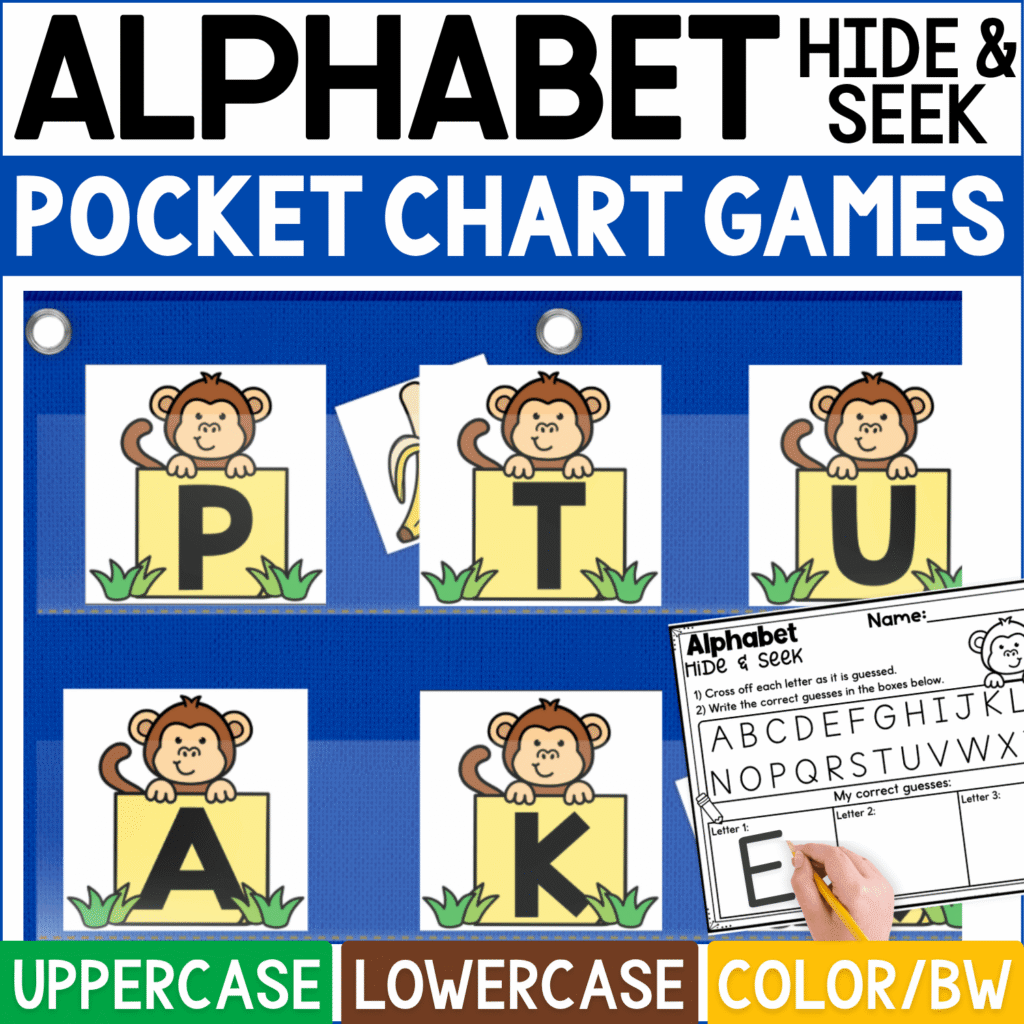


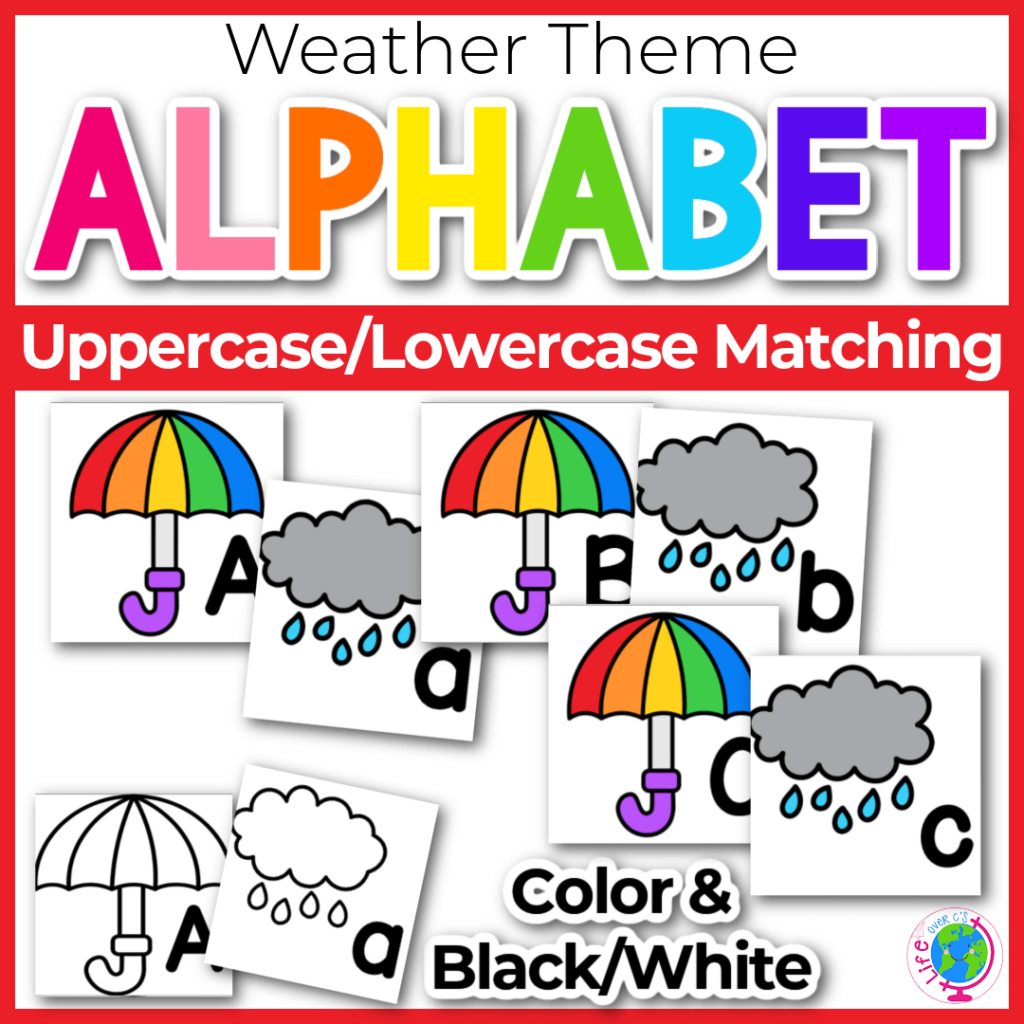
Alphabet Matching Game: Monkey and Banana
- 26 uppercase letter cards on monkeys (A-Z)
- 26 lowercase letter cards on bananas (a-z)
Print the cards in color. Print on cardstock and laminate for extra durability.
Required Materials:
- Paper, Printer, Ink
- Cardstock (optional)
- Scissors or paper cutter
- Laminator (optional)
Standards for Alphabet Knowledge and Phonics
Matching the cards gives kids repeated practice recognizing uppercase and lowercase letters and pairing the two forms.
Common Core State Standards: English Language Arts
- CCSS.ELA-LITERACY.RF.K.1.D: Recognize and name all upper- and lowercase letters of the alphabet.
- CCSS.ELA-LITERACY.RF.K.3.A: Demonstrate basic knowledge of one-to-one letter-sound correspondences.
Texas Prekindergarten Guidelines and TEKS for English Language Arts and Reading
- PK4.III.C.1: Child recognizes and names at least 20 letters.
- PK4.III.C.2: Child recognizes at least 20 distinct letter-sound correspondences.
- TEKS ELA K.2(D)(v): Demonstrate print awareness by identifying all uppercase and lowercase letters.
Virginia English Standards of Learning
- K.FFR.3.A: Identify capital and lowercase letters of the alphabet.
- K.FFR.3.B: Identify common letter-sound correspondences.
Alphabet Matching Game: Monkey and Banana is an uppercase and lowercase letter matching game that helps preschool and kindergarten kids pair every letter with its partner.
Find the partner! The set has 26 uppercase letter cards on monkeys and 26 lowercase letter cards on bananas. Kids match each uppercase letter to its lowercase partner, so every monkey gets its banana.
Matching uppercase and lowercase letters helps kids learn that A and a are the same letter, even though they look different. That connection matters every time they open a book.
Play it face up like a puzzle, face down as a matching game or hide the cards in a sensory bin for a letter hunt.
Print on cardstock and laminate for extra durability.
How to Use Alphabet Matching Game: Monkey and Banana
- Print the cards in color on cardstock, laminate and cut them apart.
- Choose the letters you want to practice.
- Lay the cards face up or face down.
- Find an uppercase letter and its lowercase partner.
- Name the letter and say its sound for every match.
Small Group: Play the matching game with 2 to 4 kids and say each letter sound as pairs are found.
Independent Practice: Put a few pairs in a literacy center and let kids match them like a puzzle.
Easy Ways to Differentiate This Letter Matching Game
Some kids in your group are still learning letter names, some know the letters but not their sounds and some are ready to read and write words. The monkey and banana cards stay the same. What changes is how many pairs are in play, whether cards are face up or face down and what kids say with each match.
For Children Who Need More Support:
- Start with the letters in the child’s name from the monkey and banana cards. Kids already care about those letters, so they stay with the game longer.
- Pick four or five monkey and banana pairs that look alike in both forms, like Cc, Oo, Ss and Ww. Kids learn the routine before facing pairs like Gg and Rr.
- Lay the monkey and banana cards face up and match them like a puzzle. Face up keeps the focus on letters instead of remembering where cards are.
- Before matching, have the child trace the uppercase letter on the monkey and banana card with a finger and name it. Tracing gives a second way to notice the shape.
For On-Level Practice:
- Play face down with 10 to 13 monkey and banana pairs. Kids have to recognize each letter on its own instead of spotting it in a row.
- Have kids name the letter on each monkey and banana they flip and say its sound when they make a match. Saying both links the name, the shape and the sound.
- After kids pair each monkey with its banana, ask what is the same and what is different about the two letters. Explaining the difference helps kids keep the forms straight.
- Line up the finished monkey and banana pairs in ABC order. Ordering the pairs adds alphabet order practice to the game.
For an Extra Challenge:
- Play with all 26 monkey and banana pairs. The longer game builds focus and gives kids lots of review.
- Have kids say a word that starts with each letter they match, starting with a theme word like M for monkey or B for banana. A word of their own shows they know the sound.
- Pull out the monkey and banana pairs kids often confuse, like b and d or p and q, and play with only those. Practicing tricky letters side by side helps kids tell them apart.
- Have kids feed each monkey its banana by sliding the lowercase card under the uppercase card. Feeding the monkey makes the match playful.
For Speech, OT, ELL or Special Education Support:
- Laminate the monkey and banana cards so little hands can pick them up and flip them more easily. Sturdy cards also last through many games.
- For speech practice, choose monkey and banana pairs for the child’s target sound. Theme words like monkey, banana and munch give practice with /m/ and /b/.
- For ELL support, teach monkey, banana, peel and eat and model “uppercase A, lowercase a” for kids to repeat. Clear phrases help kids name each match.
Alphabet Matching Game: Monkey and Banana Is Perfect For:
- Preschool and pre-K
- Kindergarten
- Letter of the week
- Literacy centers
- Morning tubs
- Small-group instruction
- Reading intervention
- Special education
- Speech, OT and early intervention sessions
- ELL and multilingual learners
- Homeschool preschool and kindergarten