

Fine Motor Mats Pattern Blocks: Summer
Recommended Grade Level:
Type of Resource: PDF
Number of Pages: 19
Coordinating Activities


Summer Pattern Block Mats
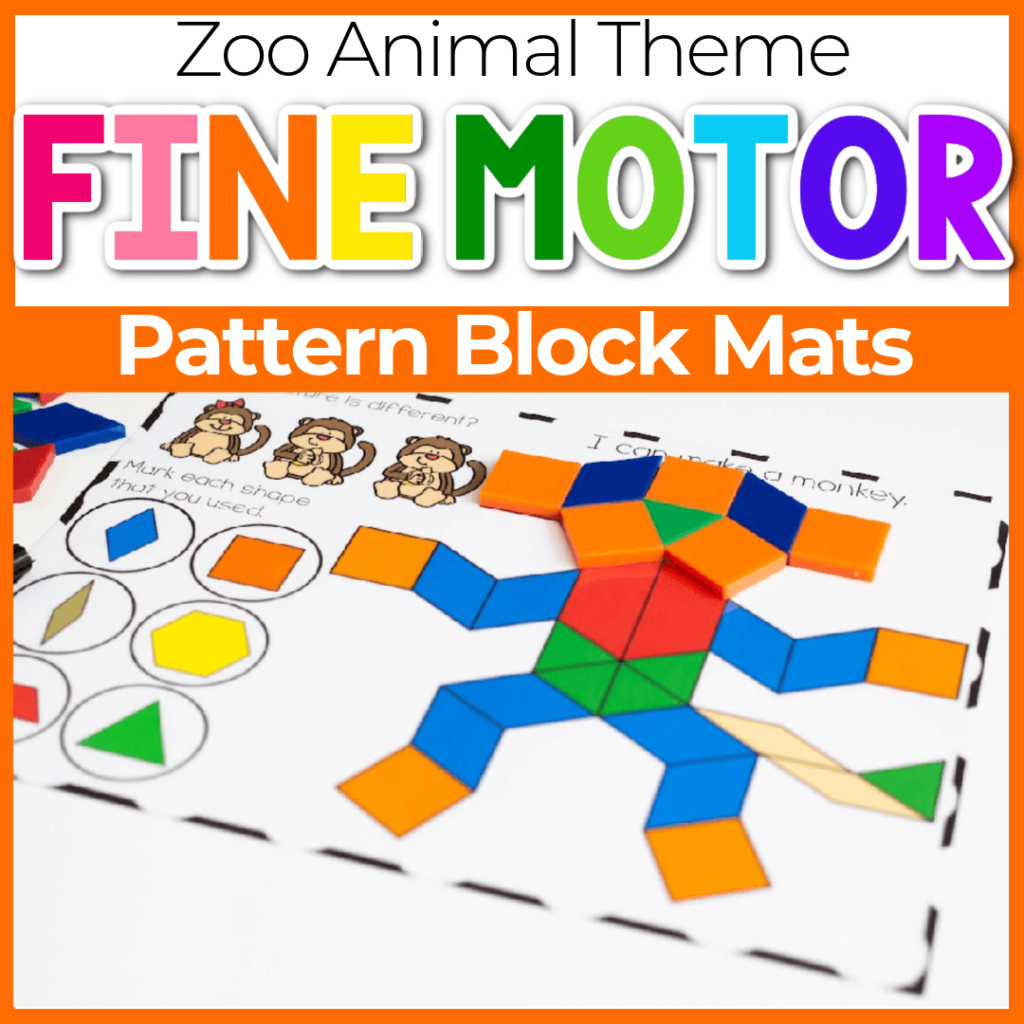
- Set 1: 10 full-page mats. Each one has a color pattern block picture to build with an “I can make a ___.” label, a “Which picture is different?” box with four small pictures to compare and a “Mark each shape that you used” row with the six pattern block shapes.
- Set 2: black-and-white outline templates with the same pictures. Kids place blocks right inside the lines. Most are half-page.
- Pictures: anchor, beach ball, boat, crab, fish, ice cream cone, sandcastle, shell, starfish and sun.
19 pages in all. Print Set 1 in color so kids can match block colors and laminate the mats for use with a dry-erase marker.
Required Materials
- Standard pattern blocks (yellow hexagons, red trapezoids, blue rhombuses, tan rhombuses, green triangles and orange squares)
- Laminator or sheet protectors
- Dry-erase marker for marking shapes and circling the picture that is different
- Scissors or a paper cutter for the half-page templates
- Paper, printer and ink
Standards for Shapes, Visual Skills and Fine Motor Skills
These summer pattern block mats support early standards for naming shapes, putting shapes together to make new shapes, reading simple sentences and using small hand muscles with control.
Common Core State Standards: Mathematics
- CCSS.MATH.CONTENT.K.G.B.6: Compose simple shapes to form larger shapes. Kids put triangles, rhombuses and hexagons together to make the sandcastle, crab and sun.
- CCSS.MATH.CONTENT.K.G.A.2: Correctly name shapes regardless of their orientations or overall size. Kids mark each shape they used, even when it’s turned a different way in the picture.
Common Core State Standards: English Language Arts
- CCSS.ELA-LITERACY.RF.K.3.C: Read common high-frequency words by sight. Every mat repeats the sentence starter “I can make.”
Texas Prekindergarten Guidelines and TEKS
- PK4.V.C.1: Child names and describes common 2D shapes. Kids name the shapes in the “Mark each shape that you used” row.
- PK4.V.C.2: Child creates shapes using materials and/or manipulatives. Kids create each picture with real pattern blocks.
- PK4.V.C.4: Child recognizes common shapes, regardless of orientation and size. Blocks are turned many different ways in each picture.
- PK4.IX.B.1: Child shows control of tasks that require small-muscle strength and control. Picking up and placing small blocks builds finger control.
- PK4.IX.B.2: Child shows increasing control of tasks that require eye-hand coordination. Kids line up each block inside the outline.
- TEKS K.6(A): Identify two-dimensional shapes, including circles, triangles, rectangles and squares as special rectangles. Kids identify the triangles and squares they use.
Virginia Mathematics Standards of Learning
- K.MG.2.a: Identify and name circles, triangles, squares and rectangles in concrete and pictorial forms, regardless of orientation. Kids find the triangles and squares in each picture.
- K.MG.2.f: Construct these figures using materials. Kids build pictures from real blocks, including triangles and squares.
These summer pattern block mats invite preschool and kindergarten kids to build sandcastles, crabs and ice cream cones with pattern blocks while they practice shapes, visual discrimination and fine motor skills.
Build a sandcastle without getting sand in anyone’s shoes! These summer mats bring beach days to the table with crabs, boats, shells and more.
Each full-page mat shows a color picture to build with pattern blocks. Kids match each block, mark the shapes they used and solve a “Which picture is different?” puzzle.
The second set is black-and-white outline templates. Kids choose each block by looking at the shape of the space, which stretches their thinking beyond color matching.
Pattern blocks are a great summer tool because they work for so many ages at once. A preschooler can match colors on the sun while an older sibling builds the sandcastle from an outline. Same tub, same table, different challenges.
The 10 Summer Pictures
Here’s what kids build:
- Anchor
- Beach ball
- Boat
- Crab
- Fish
- Ice cream cone
- Sandcastle
- Shell
- Starfish
- Sun
How to Use Summer Pattern Block Mats
- Choose a summer picture and gather a tub of blocks.
- Place a matching block on each shape until the picture is done.
- Mark the shapes you used and find the picture that’s different.
Small Group: Build the sun together and count how many triangles make its rays. Kids love seeing how one shape repeats all the way around.
Independent Practice: Set the mats out at summer school, summer camp or a kitchen table with a bin of blocks.
Tips for Smooth Pattern Block Time
- Keep blocks in a beach bucket for a fun summer center.
- Laminate the mats so they hold up to sticky summer hands.
- Put each finished picture on a tray so kids can show it off before cleanup.
Easy Ways to Differentiate These Summer Pattern Block Mats
Summer groups often mix ages and skills so these ideas cover a wide range.
For Children Who Need More Support:
- Start with the fish or the shell. They use fewer blocks. A quick finish builds confidence before the bigger sandcastle.
- Give kids a sorting tray with one shape in each section. When each shape has its own place, kids spend their energy on building instead of searching.
- Build the first row of the sandcastle together, then let the child finish. Working side by side shows how the blocks fit the spaces. Kids carry that confidence into the rest of the picture.
- Stick with the color mats until matching feels easy. The colored spaces show which block goes where. Kids can focus on turning and fitting each block instead of choosing shapes.
For On-Level Practice:
- Build the crab and count each shape you used. Kids name each shape as they count it. That builds shape words and counting in the same moment.
- Find the different picture in the small box and explain the change. Kids use words like bigger, smaller and turned. Describing what they see builds the position words they need for math talk.
- Compare the boat and the anchor. Which one used more blocks? Kids count both and decide. Comparing two totals is an important kindergarten math skill.
For an Extra Challenge:
- Build the sandcastle on an outline template with no color clues. Kids have to look at each space and decide which shape fits. That turns matching into real problem solving.
- Rebuild the ice cream cone using different blocks. Kids discover new ways to make the same shape.
- Design a beach scene with three pictures and tell a story about it. Building and storytelling make a great pair.
For Speech, OT, ELL or Special Education Support:
- OT: Build on a vertical surface with magnetic pattern blocks if you have them. Working on an upright surface strengthens the shoulder and wrist. Those muscles steady the hand for writing.
- Speech: Practice /s/ with sun, shell, sandcastle and starfish. Say the word as the last block goes on. Four /s/ pictures give plenty of practice in one sitting.
- ELL: Talk about a day at the beach using the pictures before building. Talking first gives kids words to use while they build.
- Special education: Build one color at a time, all the yellow blocks first, then the next color. Working one color at a time keeps the picture manageable.
Perfect For
- Summer school and camp stations
- End-of-year centers
- OT sessions
- Homeschool summer learning
- Quiet time bins